The most tested grammar rules SAT ACT students meet are a short list: about two dozen rules cover most of the grammar questions on both tests. This page puts 25 of them in one table, each with a typical error and its fix: sentence boundaries, punctuation, agreement, verb tense, pronouns, modifiers, parallel structure, comparisons, transitions, and concision.
The list is my own summary. Neither the College Board nor ACT, Inc. publishes a ranking of rules by frequency, so I chose the rules from their published skill categories and from the usual content of test preparation. Use it as a checklist of SAT ACT grammar rules (SAT grammar rules and ACT grammar rules), then practice each one in the format of your test. The page ends with 30 exercises and a 10-question quiz. Test formats change, so check the official sites before you test.
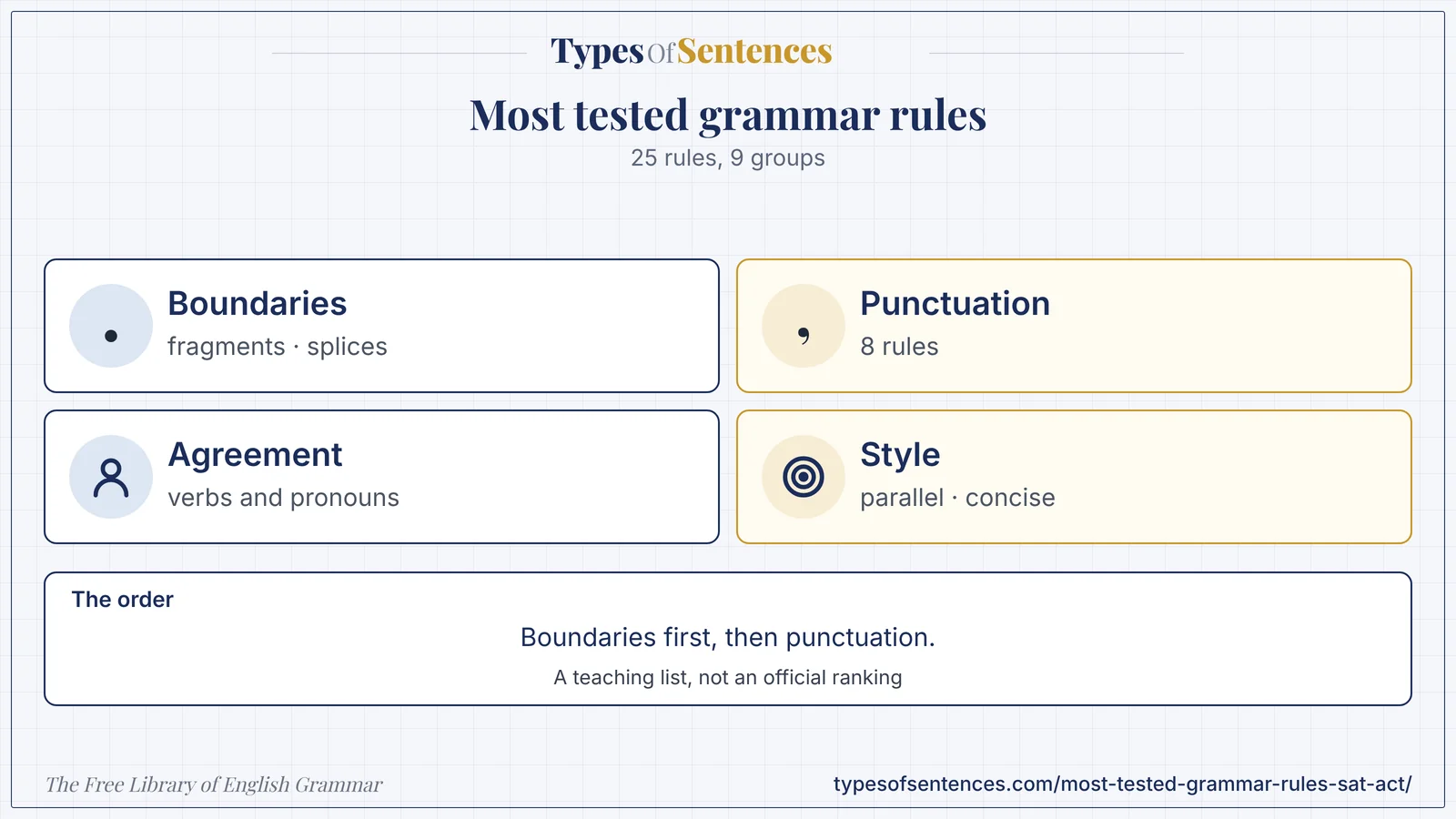
The most tested grammar rules SAT ACT students face are few: a small group of rules causes most of the grammar errors on both tests.
Why it matters: Learn the 25 rules in the table, one at a time, and practice each with real test-style questions.
Summary: The most tested rules fall into ten groups: complete sentences, boundaries (comma splices and run-ons), punctuation (semicolons, colons, commas, apostrophes), agreement, verbs, pronouns, modifiers, structure (parallelism and comparisons), and expression (transitions and concision). The list on this page has 25 rules, each with an error and a fix. It is a teaching list, not an official one: no test maker publishes a frequency ranking. Learn the rules once; both tests use them. The ACT puts more weight on style and organization, and the SAT puts the grammar questions in the Reading and Writing section.
- 25 rules, 10 groups.
- Both tests use them.
- Not an official ranking.
- Practice in test format.
What You’ll Learn
1. Most Tested Grammar Rules SAT ACT: The Short Answer
| Group | Rules | Count |
|---|---|---|
| complete sentences | fragments | 1 |
| boundaries | comma splice, run-on | 2 |
| punctuation | semicolon, colon, subject-verb comma, extra information, introductory comma, list commas, apostrophes, contractions | 8 |
| agreement | intervening phrase, inverted order | 2 |
| verbs | tense consistency, perfect tenses | 2 |
| pronouns | antecedent, case, who and whom, clarity | 4 |
| modifiers | dangling, misplaced | 2 |
| structure | parallelism, logical comparison | 2 |
| expression | transitions, concision | 2 |
The groups follow the skill categories of the digital SAT (Standard English Conventions and Expression of Ideas) and the Enhanced ACT (Conventions of Standard English, Production of Writing, and Knowledge of Language), found by web search on 12 Nov 2026; the official pages were not opened. For the SAT, see the guide to SAT grammar rules, and for the ACT, the guide to ACT English grammar rules.
2. The 25 Rules: Error, Fix, and Where They Appear
| # | Rule | Error | Fix | Where |
|---|---|---|---|---|
| 1 | Sentence fragments (complete sentences) | *Because it rained. | We stayed in because it rained. | both |
| 2 | Comma splice (boundaries) | *It rained, we left. | It rained, so we left. | both |
| 3 | Run-on sentence (boundaries) | *It rained we left. | It rained; we left. | both |
| 4 | Semicolon between complete sentences (punctuation) | *We left; because it rained. | We left because it rained. | both |
| 5 | Colon after a complete sentence (punctuation) | *My goals are: to win. | My goal is to win. | both |
| 6 | No comma between subject and verb (punctuation) | *The boy in the hat, is my cousin. | The boy in the hat is my cousin. | both |
| 7 | Matching pair for extra information (punctuation) | *My sister, a nurse works nights. | My sister, a nurse, works nights. | both |
| 8 | Comma after an introductory clause (punctuation) | *When it ended we left. | When it ended, we left. | both |
| 9 | Commas in a list (punctuation) | *We bought eggs milk and flour. | We bought eggs, milk, and flour. | both |
| 10 | Possessive apostrophe (punctuation) | *the childrens toys | the children’s toys | both |
| 11 | Contractions and possessives (its, it’s, their, they’re) (punctuation) | *The dog wagged it’s tail. | The dog wagged its tail. | both |
| 12 | Subject-verb agreement with an intervening phrase (agreement) | *The list of names are long. | The list of names is long. | both |
| 13 | Subject-verb agreement in inverted sentences (agreement) | *There is two reasons. | There are two reasons. | both |
| 14 | Tense consistency (verbs) | *She walked in and sits down. | She walked in and sat down. | both |
| 15 | Perfect tenses and past participles (verbs) | *She has wrote two books. | She has written two books. | both |
| 16 | Pronoun-antecedent agreement (pronouns) | *The company changed their name. | The company changed its name. | both |
| 17 | Pronoun case (pronouns) | *Between you and I | Between you and me | both |
| 18 | Who and whom (pronouns) | *the student whom scores highest | the student who scores highest | both |
| 19 | Pronoun clarity (pronouns) | *When the dog met the cat, it ran away. | When the dog met the cat, the cat ran away. | both |
| 20 | Dangling modifier (modifiers) | *Walking home, the rain began. | Walking home, Maya felt the rain begin. | both |
| 21 | Misplaced modifier (modifiers) | *She served pasta to guests that was hot. | She served hot pasta to guests. | both |
| 22 | Parallel structure (structure) | *She likes hiking, swimming, and to bike. | She likes hiking, swimming, and biking. | both |
| 23 | Logical comparison (structure) | *The cost of a bus is lower than a train. | The cost of a bus is lower than the cost of a train. | both |
| 24 | Transitions (expression) | *It is large. Therefore, it is free. | It is large. Moreover, it is free. | both (more on the ACT as organization) |
| 25 | Concision and redundancy (expression) | *She returned back. | She returned. | both (more on the ACT) |
All 25 rules appear in both tests in some form, so the “Where” column notes only a difference in weight. The examples were written for this page.
3. In What Order to Study the Rules
| Stage | Rules | Why first |
|---|---|---|
| 1 | 1 to 3 (boundaries) | every other rule depends on knowing what a sentence is |
| 2 | 4 to 11 (punctuation) | the largest group |
| 3 | 12 to 16 (agreement and verbs) | short, rule-based fixes |
| 4 | 17 to 20 (pronouns) | four small rules |
| 5 | 21 to 25 (modifiers, structure, expression) | these need the most reading of context |
For deeper practice by group, see the articles on SAT punctuation rules, SAT subject-verb agreement, SAT pronoun questions, SAT verb tense questions, SAT modifier questions, and SAT parallel structure.
4. How to Use the List
| Step | What to do |
|---|---|
| 1 | take a practice set and mark the rule number for every miss |
| 2 | study the rules with the most misses first |
| 3 | write one new example for each rule you miss |
| 4 | retest the same rules after a week |
| 5 | in the last weeks, take timed sets |
| Trap | Example | What to do |
|---|---|---|
| learning rules without practice | knowing the comma rule but missing the question | do questions in test format |
| learning the rule but ignoring the sentence | a rule that fits only part of the sentence | read the whole sentence |
| overcorrecting | changing a correct sentence | keep the original if it is correct |
5. How This List Was Chosen
The list comes from three things: the published skill categories of each test, the types of errors in the practice material that the test makers release, and the usual content of test-preparation books. There is no official count of how often each rule appears, so the order of the rules is a teaching order, not a frequency table. If a rule here does not appear in your practice material, spend your time on the rules that do.
For the full rule-by-rule treatment of punctuation on the ACT, see the guide to ACT English punctuation rules, and for a set of original questions, the article on SAT grammar practice questions.
Recap in 12 seconds
Watch the lesson build itself: Twenty-five common SAT and ACT grammar rules in nine groups, each with an error and a fix. The video has no sound.
Exercises
Part A: Name the Rule (Exercises 1–10)
Exercise 1: It rained, we left.
Show Answer
Answer: comma splice.
Exercise 2: Because it rained.
Show Answer
Answer: fragment.
Exercise 3: The list of names are long.
Show Answer
Answer: agreement.
Exercise 4: The boy in the hat, is my cousin.
Show Answer
Answer: comma between subject and verb.
Exercise 5: The company changed their name.
Show Answer
Answer: pronoun-antecedent agreement.
Exercise 6: Walking home, the rain began.
Show Answer
Answer: dangling modifier.
Exercise 7: She likes to swim and biking.
Show Answer
Answer: parallelism.
Exercise 8: The childrens toys
Show Answer
Answer: apostrophe.
Exercise 9: She has wrote two books.
Show Answer
Answer: past participle.
Exercise 10: Between you and I
Show Answer
Answer: pronoun case.
Part B: Fix It (Exercises 11–20)
Exercise 11: It was late, we left.
Show Answer
Answer: It was late; we left.
Exercise 12: There is two reasons.
Show Answer
Answer: There are two reasons.
Exercise 13: She walked in and sits down.
Show Answer
Answer: She walked in and sat down.
Exercise 14: My goals are: to win.
Show Answer
Answer: My goal is to win.
Exercise 15: The student whom scores highest
Show Answer
Answer: The student who scores highest
Exercise 16: She returned back.
Show Answer
Answer: She returned.
Exercise 17: The dog wagged it’s tail.
Show Answer
Answer: The dog wagged its tail.
Exercise 18: We bought eggs milk and flour.
Show Answer
Answer: We bought eggs, milk, and flour.
Exercise 19: When it ended we left.
Show Answer
Answer: When it ended, we left.
Exercise 20: The cost of a bus is lower than a train.
Show Answer
Answer: …than the cost of a train.
Part C: Which Group? (Exercises 21–25)
Exercise 21: comma splice
Show Answer
Answer: boundaries.
Exercise 22: who and whom
Show Answer
Answer: pronouns.
Exercise 23: transitions
Show Answer
Answer: expression.
Exercise 24: colon
Show Answer
Answer: punctuation.
Exercise 25: perfect tenses
Show Answer
Answer: verbs.
Part D: Plan Your Study (Exercises 26–30)
Exercise 26: Which group should you study first?
Show Answer
Answer: boundaries.
Exercise 27: What should you write after a miss?
Show Answer
Answer: the rule number.
Exercise 28: When should you take timed sets?
Show Answer
Answer: in the last weeks.
Exercise 29: Is this list an official ranking?
Show Answer
Answer: No.
Exercise 30: Where should you check the current format?
Show Answer
Answer: the official sites.
Test Your Knowledge
Ready to check what you learned? Answer all 10 questions, then submit. You need 80% (8 of 10) to pass. Your answers are not stored.
View correct answers and explanations
Question 1: The most tested rules fall into about how many groups on this page?
✓ Correct Answer: B – 9
Nine groups in the table.
Question 2: Is the list an official ranking?
✓ Correct Answer: C – No
No test maker publishes one.
Question 3: Which rule is about two sentences joined by a comma?
✓ Correct Answer: D – comma splice
Comma splice.
Question 4: Which group should you study first?
✓ Correct Answer: A – boundaries
Boundaries.
Question 5: Which is a pronoun rule?
✓ Correct Answer: B – who and whom
Who and whom.
Question 6: Which is a modifier rule?
✓ Correct Answer: C – dangling modifier
Dangling modifier.
Question 7: She has wrote two books breaks the rule on
✓ Correct Answer: D – past participles
Past participle.
Question 8: Which tests use these rules?
✓ Correct Answer: A – both the SAT and the ACT
Both.
Question 9: After a miss you should
✓ Correct Answer: B – write the rule number
Write it down.
Question 10: Where do you check the current format?
✓ Correct Answer: C – official sites
Official sites.
Frequently Asked Questions
What are the most tested grammar rules on the SAT and ACT?
The most tested grammar rules SAT ACT students meet are sentence boundaries, punctuation, agreement, verb tense, pronouns, modifiers, parallel structure, comparisons, transitions, and concision. This page lists 25 of them.
What are the SAT grammar rules I must know?
The SAT grammar rules in this list cover boundaries and conventions: fragments, comma splices, punctuation, agreement, tense, pronouns, modifiers, parallelism, and transitions.
What are the ACT grammar rules I must know?
The ACT grammar rules overlap with the SAT rules and add more weight on style: concision, word choice, and organization. The ACT also uses NO CHANGE as a choice.
Is there an official list of the most tested rules?
No. Neither the College Board nor ACT, Inc. publishes a ranking by frequency. This list is a teaching summary built from the published skill categories.
Are the SAT and ACT grammar rules the same?
Mostly. The SAT ACT grammar rules overlap on conventions; the formats and the weight of style questions differ.
How long does it take to learn the 25 rules?
It depends on where you start. Many students need a few weeks of short daily sessions with an error log to feel secure, but this is a general estimate and not a promise.
Which rule should I learn first?
Start with sentence boundaries (fragments, comma splices, run-ons), because every other rule assumes that you can find a complete sentence.
Conclusion
You now have a table of the most tested grammar rules SAT ACT students need, 25 rules in nine groups, each with an error and a fix, and a study order. You know that the list is a teaching summary and not an official ranking.
Treat these SAT ACT grammar rules as one shared checklist. Start with boundaries, practice each rule in the format of your test, and keep a log of your misses. Next, use the practice sets on this site to test yourself on the rules.
- College Board. Digital SAT Suite of Assessments: Reading and Writing (test specifications).: the skill categories (found by web search on 12 Nov 2026; the page was not opened; please check satsuite.collegeboard.org).
- ACT, Inc. Preparing for the ACT and the ACT English test description.: the reporting categories (found by web search on 12 Nov 2026; act.org was not opened).
- Strunk, William, Jr., and E. B. White. The Elements of Style. 4th ed. Longman, 2000.: the rules the list draws on.
- Merriam-Webster Dictionary: grammar: the dictionary entry (not opened when this page was written). The list and its order are my own teaching summary and are not an official ranking.
Last reviewed: October 29, 2026. How it was made: drafted with AI assistance, then checked with automated tests (structure, links, answer keys, spelling) and against the sources above. A person has not yet read this chapter line by line. Found a mistake? Report it.