Grammar in professional communication is judged by a particular audience: colleagues, managers, clients, and regulators who read quickly, act on what they read, and form an impression of the writer from the text. A message with a clear subject, a stated request, and a correct sentence structure says that its writer is competent and respects the reader’s time. A message with a misplaced modifier that changes the meaning of an instruction, a missing article that makes a request ambiguous, or a tangle of nominalizations that hides who must do what can cost money, delay a project, or damage a relationship. Workplace grammar is therefore practical: it is the grammar of getting things done correctly.
This chapter sets out the grammar conventions of the main kinds of workplace writing. It covers standards in the workplace, the grammar of emails (grammar for emails and reports begins with the same principles of clarity), reports and proposals, presentations and slides, meeting minutes, other documents such as procedures and status updates, and the clear grammar that helps international colleagues. It is a chapter on workplace writing skills and corporate communication in the sense that it applies the grammar of the course to a defined setting; it does not replace the house style of any organization, which always has priority. Thirty exercises and a quiz follow.
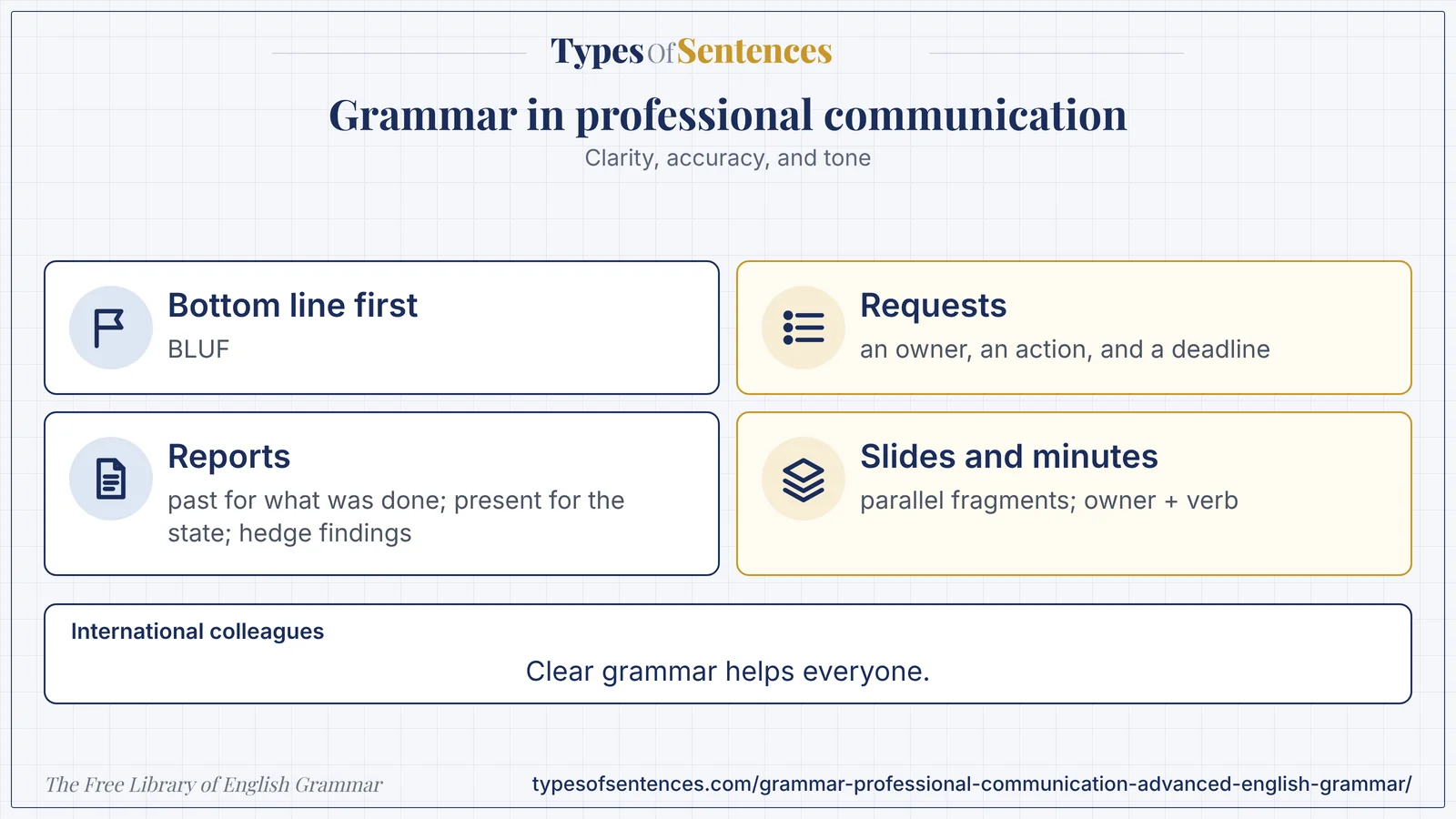
At work, people read to decide and to act. Write so that they can do both without having to ask you what you meant: put the main point or request first, say who must do what and by when, use plain verbs and clear sentences, and keep the same terms from start to finish.
Why it matters: Correct grammar is part of credibility, but the aim is clarity. A short, clear, correct message beats a long, impressive, confusing one.
Summary: Professional writing is judged on clarity, accuracy, and tone. Good practice is to put the bottom line first (BLUF), state requests with an owner, an action, and a deadline, and use consistent terms. Emails use specific subject lines, short paragraphs, and polite modals. Reports use the past tense for what was done and found and the present tense for current states and conclusions, hedge findings appropriately, use parallel headings and lists, and keep recommendations in clear modal or imperative forms. Presentations use spoken grammar (short sentences, signposts, repetition) and parallel slide bullets. Meeting minutes record discussion in the past tense and actions with owner, verb, and deadline. Procedures use the imperative; policies use modal verbs. Cross-cultural communication favors explicit, low-context wording, unambiguous dates, and no idioms. A house style sheet records decisions. Proofreading protects credibility.
- Bottom line first; owner, action, deadline.
- Report: past for done, present for state; hedge findings.
- Slides: parallel fragments; minutes: owner + verb + date.
- Clear grammar for international colleagues.
What You’ll Learn
- 1. Grammar in Professional Communication: Importance and Standards
- 2. Email Etiquette: Grammar Conventions in the Workplace
- 3. Reports and Proposals: Formal Grammar
- 4. Presentations: Spoken Grammar and Slides
- 5. Meeting Minutes: Grammar Conventions
- 6. Cross-Cultural Communication: Clear Grammar for International Colleagues
- 7. Other Workplace Documents: Procedures, Policies, Reviews, and Applications
- 8. Common Problems and a Worked Example
- 9. Exercises
- 10. Test Your Knowledge
- 11. Frequently Asked Questions
- 12. Conclusion
1. Grammar in Professional Communication: Importance and Standards
| Why grammar matters at work | Explanation |
|---|---|
| credibility | readers often infer competence and care from the writing; errors can distract or undermine trust |
| clarity and action | instructions and requests must be understood the first time |
| risk and cost | ambiguity in a contract, a safety instruction, or a client message can cause errors and disputes |
| efficiency | clear writing reduces questions, rework, and meetings |
| consistency of the organization’s voice | customers and staff read many documents; a consistent style builds recognition |
| inclusion | plain and inclusive wording helps colleagues of different backgrounds |
| legal and regulatory exposure | records may be used as evidence; wording matters |
| career impact | writing is visible to managers and clients |
| international reach | many workplaces are multilingual and global |
| searchability and records | clear subject lines and terms make documents findable |
| Document or setting | Grammar profile | Typical choices |
|---|---|---|
| email to a colleague | neutral; short; direct | full sentences; a request with a deadline |
| email to a client | formal to neutral; courteous | polite modals; no slang |
| internal chat message | informal to neutral | short; clear ask; mentions |
| status update | concise; factual | present perfect and present; lists |
| incident report | factual; chronological | past tense; no blame; precise times |
| root cause analysis | causal; precise | connectors of cause and effect; past and present |
| change request | precise; formal | present tense for the proposed change; modals for risk |
| proposal | persuasive; structured | benefit-focused; you and we; future for promises |
| business report | formal; evidence-based | past for method and findings; present for conclusions; hedging |
| executive summary | compressed; self-contained | short sentences; the main findings first |
| presentation | spoken; signposted | short sentences; repetition; questions |
| slides | fragments; parallel | a verb or noun phrase pattern per list |
| meeting agenda | list; parallel | noun phrases or questions |
| meeting minutes | neutral; record | past for discussion; owner + verb + date for actions |
| standard operating procedure | imperative; sequential | one action per step |
| policy | formal; normative | modals (must, may, should) |
| job description | parallel; concise | verbs in a list |
| performance review | balanced; specific | examples; tentative and firm modals |
| feedback to a colleague | tactful; specific | I statements; concrete behavior |
| customer service reply | courteous; clear | empathy; a plain solution |
| contract or SLA | precise; formal | defined terms; modal verbs; parallel clauses |
| press release | third person; news style | present tense for the announcement; quotations |
| résumé or CV | parallel fragments | action verbs; past tense for past roles |
| cover letter | formal; persuasive | first person; specific achievements |
| LinkedIn profile | semi-formal; first person | present and past; short paragraphs |
| training material | instructional; plain | imperatives; examples |
| intranet article | neutral; scannable | headings; short paragraphs |
| newsletter | friendly; clear | — |
| escalation message | urgent; precise | a clear subject; facts; the ask |
| handover note | precise; complete | present perfect and present; lists |
| risk register entry | precise | a noun phrase for the risk; a clause for the impact |
| business case | persuasive; evidence-based | comparatives; numbers; recommendations |
| terms of reference | formal; list | — |
| audit finding | precise; neutral | evidence; criteria; cause; effect |
| regulatory submission | formal; exact | defined terms; passive for process |
| memo | short; direct | a clear subject line; the point first |
| agenda email | structured | — |
| A style sheet for workplace writing records | Example |
|---|---|
| person and voice | we for the organization; active voice preferred |
| capitalization | sentence case for headings; capitalized product names |
| numbers and dates | figures for 10 and above; 4 March 2024 |
| abbreviations | spell out on first use; a glossary |
| preferred terms | customer, not client and user |
| punctuation | serial comma; en dashes for ranges |
| spelling variety | US or UK, consistently |
| tone | plain, courteous, direct |
| forms of address | first names for colleagues; titles for clients |
| templates | for emails, reports, minutes |
| hyphenation and compounds | follow-up (noun); follow up (verb) |
| units and currency | metric units; ₹ or USD with the currency code |
| time zones | state the zone |
| links and file names | descriptive |
| approvals and review | who reviews what |
The general principles of business writing are treated in the chapter on business writing, and the specific conventions of email in the chapter on email and digital communication; this chapter adds the grammar of the longer and more formal genres, and of meetings. A house style, where it exists, overrides general guidance, and where it does not exist, a short style sheet saves time.
2. Email Etiquette: Grammar Conventions in the Workplace
| Principle | Weak version | Stronger version |
|---|---|---|
| bottom line up front (BLUF) | I was reviewing the figures and noticed several things, and after discussing with the team, I think we should approve the budget. | Please approve the budget. The figures are consistent, and the team agrees. |
| a request with an owner, an action, and a deadline | It would be good if the report could be done soon. | Raj, please send the draft report by 5 p.m. on Thursday. |
| a specific subject line | Update | Update: server migration completed on 4 March |
| one topic per email | — | separate emails for separate topics |
| short paragraphs | a 200-word block | paragraphs of two to four sentences |
| polite modals | Send me the file. | Could you please send me the file? |
| direct but courteous | You did not attach it. | The attachment seems to be missing. Could you resend it? |
| avoid blame | You made a mistake in the invoice. | The invoice shows ₹5,000; the order was ₹4,500. Could you check? |
| active voice | The decision has been made by management. | Management has decided. |
| specific verbs | We need to look at the issue. | We need to investigate the issue. |
| avoid vague time words | soon, ASAP | by Friday; today |
| name the attachment | — | I have attached the revised budget (Budget_v2.xlsx). |
| summarize long threads | — | Summary: we agreed to move the launch to May. |
| decline politely | I can’t do that. | I am not able to take this on this week. Could we discuss priorities? |
| apologize briefly | I am so very sorry for the terrible delay. | I apologize for the delay. The report will reach you today. |
| follow up courteously | Why haven’t you replied? | I am following up on my message of 4 March. Could you let me know by Friday? |
| escalate clearly | This is a disaster. | The customer’s service is down. We need a decision by 3 p.m. on whether to roll back. |
| thank specifically | Thanks for everything. | Thank you for reviewing the proposal so quickly. |
| ask a question clearly | Any thoughts? | Do you approve option B? |
| give feedback tactfully | This is poorly written. | The introduction would be clearer with a summary in the first paragraph. |
| avoid cliché | I hope this finds you well. | Thank you for your message. |
| avoid ambiguity | Please review the document and the chart and send it back. | Please review the document and the chart, and send both back. |
| avoid unclear pronouns | Tell Priya that she should give it to him. | Tell Priya to give the report to Raj. |
| use parallel lists | Please bring your ID, to sign the form, and a photograph. | Please bring your ID, a signed form, and a photograph. |
| confirm understanding | — | To confirm: we will meet on Monday at 10 a.m. IST. |
| mind time zones | Call me tomorrow at 9. | Call me on Tuesday, 5 March, at 9 a.m. IST (3:30 a.m. UTC). |
| reply to the question asked | — | answer each question in order |
| use CC and BCC properly | — | CC for information; BCC to protect addresses |
| sign off consistently | — | Best regards, [name] |
| write for mobile | — | short subject; short paragraphs |
| keep records of decisions | — | a summary email after a call |
| mark urgency honestly | URGENT (for everything) | Urgent: needs a reply by 3 p.m. |
| avoid forwarding without a note | FW: | FYI: the new policy, for Friday’s meeting. |
Email conventions in general, including greetings, closings, and abbreviations, are covered in the chapter on email and digital communication; the point here is the habit of treating each email as a small document with a purpose, a reader, and a requested action.
3. Reports and Proposals: Formal Grammar
| Section of a report | Typical grammar | Example |
|---|---|---|
| executive summary | short, present and past, self-contained; the conclusion first | The pilot reduced response times by 20 percent. We recommend a full rollout. |
| background | past and present perfect | The team has used the old system since 2019. |
| purpose and scope | present and infinitive | This report assesses the pilot and recommends next steps. |
| method | past tense, often passive | Data were collected from 120 users between January and March. |
| findings | past tense for results; present for general statements; hedging | Response times fell from 8 to 6.4 minutes. This suggests that the new process is faster. |
| discussion | present tense for interpretation; modals for possibility | The result may reflect the smaller team size. |
| conclusions | present tense; firm but accurate | The pilot succeeded in its main aim. |
| recommendations | imperative or modal | We recommend that the board approve the rollout. The team should train staff first. |
| limitations | hedging; past tense | The sample was small and limited to one site. |
| next steps | future; imperative; lists | Finalize the budget by April. |
| appendices | labels; lists | — |
| Feature of formal report grammar | Guidance | Example |
|---|---|---|
| tense consistency by section | past for what was done; present for what is true now | — |
| voice | active (we) where acceptable; passive for methods | We interviewed 20 users. / Users were interviewed. |
| hedging and boosting | match the evidence | The data suggest … / The data show … |
| precise numbers | figures with units; consistent decimals | 6.4 minutes |
| parallel headings | same grammatical form | Findings; Discussion; Recommendations |
| signposting | tell the reader where you are going | This section explains why the project was delayed. |
| cohesion | link ideas with connectors | However, the cost rose. As a result, we revised the plan. |
| topic sentences | state the point of each paragraph first | — |
| lists for items and steps | parallel items | — |
| tables and figures | a label and a title; refer to them in the text | Table 2 shows the costs. |
| definitions of terms | at first use | — |
| avoid nominal strings | — | not implementation delay risk assessment findings |
| neutral tone | avoid emotive words | — |
| attribution | say who said or found what | The audit team found … |
| citations | follow the style guide | — |
| recommendations tied to findings | each follows from evidence | — |
| modals of obligation and advice | must, should, could have different weights | must (required); should (advised); could (possible) |
| headings as questions or statements | consistent | — |
| active verbs in recommendations | Approve; train; review | — |
| executive summary last, read first | write it after the report | — |
| formal register | no contractions in formal reports | — |
| numbers | consistent style | — |
| dates | unambiguous | 4 March 2024 |
| page and section references | — | see section 3 |
| proofreading | by someone else | — |
| version and date | state | — |
| confidentiality notes | as required | — |
| accessibility | headings; alt text for figures | — |
| executive tone | confident without overclaiming | — |
| readability | sentences of about 15 to 25 words on average | — |
| Proposal grammar | Example |
|---|---|
| state the problem clearly | Our current process loses about two hours per incident. |
| state the solution as a benefit | The new tool will cut that time by half. |
| use you and we | We will train your team in two sessions. |
| use the future for promises that you can keep | We will deliver by 30 June. |
| use modals carefully | We can deliver in six weeks (not should be able to if you can commit). |
| state costs and terms precisely | The total is ₹4,50,000, payable in three installments. |
| state assumptions | This estimate assumes that access is available by 15 March. |
| state risks and mitigations | If access is delayed, we will adjust the schedule. |
| use evidence | In a pilot, error rates fell by 30 percent. |
| end with a clear next step | Please confirm by 15 March so that we can begin. |
| avoid overclaiming | not the best solution in the world |
| keep to plain language | — |
| Incident report and root cause analysis (RCA) grammar | Guidance | Example |
|---|---|---|
| facts first | what happened, when, where, who was affected | At 14:05 IST on 4 March, the payment service stopped responding. |
| chronological order in the past tense | precise times | At 14:10, the team received an alert. At 14:25, the team restarted the service. |
| no blame in the narrative | describe actions, not character | The change was deployed without a rollback plan. |
| impact stated with numbers | — | About 1,200 transactions failed. |
| cause and effect connectors | because, as a result, which caused | The disk filled because log files were not rotated, which caused the service to stop. |
| root cause versus contributing factors | distinguish them | The root cause was …; contributing factors included … |
| present tense for the current state | — | The service is stable. |
| actions in the imperative or with owners | — | Priya: add log rotation by 11 March. |
| avoid speculation presented as fact | use hedges where unsure | The delay may have contributed to … |
| link to evidence | — | see the attached log extract |
| preventive actions in a list | parallel verbs | Add; test; document |
| lessons learned in plain sentences | — | We should test rollback plans before every release. |
The conventions above follow the general principles of technical and business writing (see the chapter on technical writing). A report is a record that others may rely on or review later, and its grammar should make the facts, the reasoning, and the recommendations distinguishable.
4. Presentations: Spoken Grammar and Slides
| Feature of spoken presentation grammar | Guidance | Example |
|---|---|---|
| short sentences | listeners cannot reread | We tested the tool. It worked. Here is why. |
| repetition and signposting | tell them what you will say, say it, tell them what you said | First, the problem. Second, the solution. Third, the cost. |
| direct address | you and we | You will see three results. |
| questions | engage the audience | What does this mean for our customers? |
| contractions | natural in speech | we’re, it’s |
| active voice | — | We reduced errors by 30 percent. |
| transitions | link sections | Now let’s move to the cost. |
| avoid reading slides aloud | — | add to the slide, do not repeat it |
| numbers spoken clearly | round and repeat key figures | About thirty percent: thirty. |
| avoid long noun strings | hard to hear | — |
| rhetorical devices in moderation | tricolon, contrast | Faster, cheaper, safer. |
| call to action | — | Please approve the plan today. |
| answering questions | repeat the question; answer directly | The question was about cost. The cost is … |
| handling a question you cannot answer | — | I do not know; I will find out and write to you by Friday. |
| speaking in a second language | prepare key phrases; use simple structures | — |
| using humor | carefully; avoid idioms in international groups | — |
| online presentations | shorter sentences; check understanding | — |
| pace | slow enough to follow; pause for translation if needed | — |
| inclusive language | — | — |
| Slide grammar | Guidance | Example |
|---|---|---|
| titles | a short phrase or a full-sentence claim (an “assertion” title) | Response times fell by 20 percent |
| bullets | parallel form (all verbs, or all noun phrases) | Reduce cost; improve speed; raise quality |
| fragments | acceptable, but consistent | — |
| punctuation | no end periods on short bullets; periods if bullets are full sentences | — |
| capitalization | sentence case or title case, consistently | — |
| numbers | figures | 20 percent |
| abbreviations | spell out on first use | — |
| words per slide | few; one idea per slide | — |
| voice | active | Customers prefer the new design. |
| verbs | strong, specific | Cut; speed; protect |
| notes | full sentences in speaker notes | — |
| labels on charts | clear and consistent | — |
| alt text | for images and charts | — |
| accessibility | contrast; readable font size | — |
| avoid the passive in bullets | — | Approve the budget (not The budget should be approved) |
| a clear final slide | a call to action, not “Questions?” alone | Next steps: approve the budget by 15 March |
| references | a source line | — |
| agenda slide | parallel items | — |
| slide transitions | a connector in the title | Next: costs |
| text in images | avoid | — |
| proofreading | check every slide | — |
Spoken grammar is closer to speech than to writing, as the chapters on rhetoric and on stylistic choices describe. A presentation that reads like a report is hard to follow, and a report that reads like a presentation lacks detail; the writer should adapt the grammar to the medium.
5. Meeting Minutes: Grammar Conventions
| Element | Convention | Example |
|---|---|---|
| heading | title, date, time, place, attendees, apologies | Project review, 4 March 2024, 10:00 IST, Room 2 |
| discussion | past tense; neutral; third person; summarizes, not verbatim | The team discussed the timeline. Priya reported that testing was complete. |
| decisions | past tense; clear and specific | The committee agreed to move the launch to May. |
| action items | owner + verb + object + deadline | Priya to send the revised plan by 8 March. |
| actions as full sentences (alternative) | — | Priya will send the revised plan by 8 March. |
| motions and votes | — | It was proposed by Raj and seconded by Priya that the budget be approved. Carried. |
| reported speech | backshift as needed | Raj said that the vendor had missed the deadline. |
| attribution | by name or role | — |
| neutral verbs | noted, reported, discussed, agreed, asked | — |
| avoid emotive words | — | complained only if accurate and relevant |
| passive voice | acceptable for decisions and impersonal records | It was decided that … |
| abbreviations | defined on first use | — |
| numbers and dates | unambiguous | 8 March 2024 |
| next meeting | date, time, place | — |
| distribution | who receives the minutes | — |
| approval | a line for approval at the next meeting | — |
| confidential items | marked | — |
| length | brief; record decisions and actions, not every remark | — |
| tone | neutral; no opinion of the minute-taker | — |
| tense in agenda items | noun phrases | Budget review |
| present tense for standing facts | The system is in production. | — |
| future for planned items | The next review will take place in April. | — |
| consistent format | a template | — |
| identification of speakers | full name at first mention | — |
| corrections | by amendment, not erasure | — |
| quoting | only when exact words matter | — |
| accuracy | check with participants if necessary | — |
| Action items: weak versus strong | Weak | Strong |
|---|---|---|
| no owner | The report should be updated. | Raj to update the report by 8 March. |
| no deadline | Priya will send the plan. | Priya will send the plan by 8 March. |
| vague verb | Look into the issue. | Investigate the cause of the failure and report by 11 March. |
| passive | A review will be done. | Anita will review the draft by 6 March. |
| several actions in one | Send the draft and update the budget and book the room. | 1. Send the draft. 2. Update the budget. 3. Book the room. |
| unclear scope | Improve testing. | Add three regression tests for the payment module. |
| unclear priority | — | High: fix the login error by 5 March. |
| no follow-up | — | Status to be reviewed at the next meeting. |
6. Cross-Cultural Communication: Clear Grammar for International Colleagues
| Practice | Why | Example |
|---|---|---|
| write explicit requests | low-context wording avoids guessing | Please send the report by Friday, 8 March, 17:00 IST. |
| state the reason for the request | — | The client needs it for Monday’s meeting. |
| avoid idioms and phrasal verbs with several meanings | they translate badly | postpone, not put off |
| avoid slang and sports metaphors | culture-bound | — |
| use short sentences with clear subjects | easier for non-native readers | — |
| write dates and times unambiguously | 03/04 is ambiguous | 4 March 2024, 15:00 UTC |
| avoid humor and irony in writing | may be misread | — |
| use plain politeness | please, thank you | — |
| do not rely on tone alone | — | state the meaning in words |
| avoid negative questions | Don’t you agree? is hard to answer | Do you agree? |
| understand directness differences | some cultures prefer indirect requests; others prefer direct ones | use clear but courteous requests |
| confirm understanding | — | Could you confirm that you understood the plan? |
| follow up in writing after calls | — | a summary email |
| avoid assumptions about holidays and weekends | — | check the calendar |
| units and currency | state both if needed | — |
| meeting grammar | speak slowly; pause; repeat key points | — |
| translate key documents professionally | — | see the chapter on translation |
| respect varieties of English | Indian, British, American, and others differ in vocabulary and style | see the chapter on global Englishes |
| Local phrase | Possible confusion | Clearer wording |
|---|---|---|
| Please revert at the earliest. | revert may be read as “go back to a previous state” | Please reply by Friday. |
| Kindly do the needful. | unclear to some readers | Please [state the action]. |
| We will touch base. | idiom | We will talk on Monday. |
| Let’s circle back. | idiom | Let’s return to this item on Tuesday. |
| It’s a no-brainer. | idiom; may sound rude | The decision is easy. |
| Can you give me a heads-up? | idiom | Can you tell me in advance? |
| We need to move the needle. | idiom | We need to make a real difference. |
| That’s a stretch. | idiom | That is unlikely. |
| I’ll ping you. | informal | I will send you a message. |
| Let’s take this offline. | jargon | Let’s discuss this after the meeting. |
| We are on the same page. | idiom | We agree. |
| Do the needful and revert. | two local forms | Please complete the task and reply. |
| As per my last email | can sound sharp | As I said in my email of 4 March, |
| Pls find attached. | abbreviated | I have attached the file. |
| Request you to … | non-standard structure for some readers | I would like to ask you to … |
Writing for international colleagues is the application of plain language and translation-friendly writing (see the chapters on grammar and translation and on plain language). It also involves respect for the varieties of English that colleagues use, as the chapter on global Englishes describes: the aim is mutual understanding, not the imposition of one variety.
7. Other Workplace Documents: Procedures, Policies, Reviews, and Applications
| Document | Grammar conventions | Example |
|---|---|---|
| procedure (SOP, runbook) | imperative; one action per step; numbered; a condition before an action | 1. Stop the service. 2. Back up the database. 3. If the backup fails, call the on-duty engineer. |
| policy | modal verbs: must (required), should (advised), may (permitted); present tense | Employees must report incidents within 24 hours. |
| guideline | should and can | Reports should be concise. |
| checklist | parallel items; imperatives or noun phrases | Check the log. Confirm the backup. |
| job description | parallel verbs | Manage the team; prepare reports; coordinate with clients. |
| performance review | specific, balanced, examples; avoid labels | Priya led the migration and met every deadline. She can improve by delegating more. |
| feedback conversation | I statements; observation, effect, request | When the report arrives late, the team cannot prepare. Could you send it by Wednesday? |
| résumé or CV | parallel past-tense verbs for past roles; present for the current role | Led a team of four; reduced response times by 20 percent. |
| cover letter | first person; formal; specific | I am applying for the role of analyst. In my current role, I manage … |
| reference letter | specific evidence; tentative and firm modals; respect for confidentiality | — |
| customer reply | empathy; a plain solution; a time frame | I am sorry that the service was interrupted. We restored it at 15:40. |
| apology | brief; specific; with an action | We apologize for the error. We have corrected your invoice. |
| announcement | present perfect or present; clear date | We have launched a new portal. It is available from Monday. |
| status update | present perfect and present; lists; blocked and next | Done: testing. In progress: training. Blocked: access. Next: launch. |
| handover note | complete; precise; present perfect | — |
| risk entry | noun phrase for the risk; clause for the impact | Vendor delay: may postpone the launch by two weeks. |
| SLA clause | defined terms; modals | The Provider shall restore service within four hours. |
| terms of reference | list; noun phrases | — |
| escalation | facts, impact, request | — |
| training manual | imperative; examples | — |
| FAQ page | questions and plain answers | — |
| internal newsletter | friendly; clear | — |
| intranet policy summary | plain summary of the policy | — |
| LinkedIn summary | first person; specific; present | — |
| performance goals | verb + object + measure + date | Reduce average resolution time from 8 to 6 hours by June. |
| ticket description | facts; steps to reproduce; expected and actual | — |
| commit message or change note (technical) | imperative; short | Fix login timeout. |
| postmortem | blameless; facts; actions | — |
| business case | problem; options; recommendation; benefits | — |
| audit finding | condition; criteria; cause; effect; recommendation | — |
The common thread is that each genre has its own grammar of action: the imperative for procedures, modal verbs for rules, past tense for records, and present tense for current states. Knowing the grammar of the genre makes a writer faster and more accurate, and a style guide or template keeps the writing consistent.
8. Common Problems and a Worked Example
| Problem | Example | Better |
|---|---|---|
| buried request | a long paragraph before the ask | put the request first |
| no deadline | Please send the file. | Please send the file by Friday. |
| unclear owner | The report needs to be updated. | Raj, please update the report. |
| inconsistent terms | client / customer / user | customer |
| jargon | synergize deliverables | work together on what we will deliver |
| passive evasion | Mistakes were made. | We made mistakes, and we are correcting them. |
| blame | You failed to … | The change was made without … |
| vague subject line | Hi | Request: approval for the budget |
| tone too casual for a client | Hey, got your note lol | Thank you for your note. |
| tone too stiff | I would be most obliged if you could kindly … | Could you please … |
| wrong tense in a report | — | past for method and findings; present for conclusions |
| overclaiming | This proves … | This suggests … |
| dangling modifier | Having reviewed the data, the report was written. | Having reviewed the data, we wrote the report. |
| ambiguous pronoun | Tell the client that he … | Tell the client, “You …” |
| long sentence | — | split |
| dense bullets | paragraph-length bullets | short parallel bullets |
| inconsistent bullet grammar | Reduce cost; improving speed; quality | Reduce cost; improve speed; raise quality |
| action item without a verb | Budget. | Raj to submit the budget by Friday. |
| unexplained abbreviation | SLA breached | service level agreement (SLA) breached |
| ambiguous date | 03/04 | 4 March |
| missing attachment | — | check before sending |
| typo in a name | — | check |
| an idiom for an international reader | touch base | talk |
| no summary in a long email | — | a summary at the top |
Rewrite for a client and manager audience (invented). Original email after a service outage: Hi all, so basically the thing went down yesterday because somebody didn’t do the disk thing, which was a total disaster, and mistakes were made, we’ll look into it asap and circle back. Pls revert if u have any thoughts. Thx
- Identify the readers and purpose: managers and clients; to inform, apologize, and say what happens next.
- Subject line: Service outage on 4 March: cause, impact, and next steps (instead of no subject).
- Bottom line first: The payment service was unavailable from 14:05 to 15:40 IST on 4 March. We have restored it, and we apologize for the disruption.
- Cause (facts, no blame): somebody didn’t do the disk thing → The service stopped because the server disk became full; log files were not being cleared automatically.
- Impact (numbers): About 1,200 transactions failed; customers can retry them. (the numbers are invented placeholders).
- Actions with owners and dates: we’ll look into it asap and circle back → Priya will add automatic log clearing by 8 March. We will send a full report by 11 March.
- Request: Pls revert if u have any thoughts → Please send any questions to me by Friday.
- Tone and closing: Thank you for your patience. Best regards, [name]
- Result: Subject: Service outage on 4 March: cause, impact, and next steps. The payment service was unavailable from 14:05 to 15:40 IST on 4 March. We have restored it, and we apologize for the disruption. The service stopped because the server disk became full; log files were not being cleared automatically. About 1,200 transactions failed, and customers can retry them. Priya will add automatic log clearing by 8 March, and we will send a full report by 11 March. Please send any questions to me by Friday. Thank you for your patience. Best regards, [name]. (the incident is invented; the times and numbers are placeholders)
Recap in 12 seconds
Watch the lesson build itself: Professional writing puts the bottom line first, states requests with an owner, action, and deadline, and uses consistent tense. The video has no sound.
Exercises
Part A: Standards (Exercises 1–6)
Exercise 1: Why does grammar matter at work?
Show Answer
Answer: Credibility, clarity and action, risk, efficiency.
Exercise 2: What is a style sheet?
Show Answer
Answer: A record of conventions (terms, numbers, punctuation) for consistency.
Exercise 3: What does BLUF mean?
Show Answer
Answer: Bottom line up front.
Exercise 4: Name a workplace document and its tense.
Show Answer
Answer: Incident report: past; procedure: imperative; policy: modals.
Exercise 5: Should a house style override general guidance?
Show Answer
Answer: Yes.
Exercise 6: Name a feature of professional tone.
Show Answer
Answer: Plain, courteous, direct.
Part B: Email (Exercises 7–13)
Exercise 7: Improve: Update (subject).
Show Answer
Answer: Update: server migration completed on 4 March.
Exercise 8: Improve: It would be good if the report could be done soon.
Show Answer
Answer: Raj, please send the draft report by 5 p.m. on Thursday.
Exercise 9: Improve: You made a mistake in the invoice.
Show Answer
Answer: The invoice shows ₹5,000; the order was ₹4,500. Could you check?
Exercise 10: Replace: ASAP.
Show Answer
Answer: A date and time.
Exercise 11: Improve: I can’t do that.
Show Answer
Answer: I am not able to take this on this week. Could we discuss priorities?
Exercise 12: When to use CC?
Show Answer
Answer: For information.
Exercise 13: Why state the time zone?
Show Answer
Answer: Colleagues may be in different places.
Part C: Reports and Proposals (Exercises 14–19)
Exercise 14: Tense for the method in a report.
Show Answer
Answer: The past (often passive).
Exercise 15: Tense for a conclusion.
Show Answer
Answer: The present.
Exercise 16: Soften: This proves the theory.
Show Answer
Answer: This suggests the theory may hold.
Exercise 17: Name a modal of obligation and one of advice.
Show Answer
Answer: must (required); should (advised).
Exercise 18: What goes first in an incident report?
Show Answer
Answer: The facts: what, when, where, impact.
Exercise 19: Why avoid blame in an RCA?
Show Answer
Answer: It keeps the report factual and constructive.
Part D: Presentations and Minutes (Exercises 20–25)
Exercise 20: Make a bullet parallel: Reduce cost; improving speed; quality
Show Answer
Answer: Reduce cost; improve speed; raise quality.
Exercise 21: Why avoid reading slides aloud?
Show Answer
Answer: The audience reads faster than you speak; add to the slide.
Exercise 22: Name a feature of spoken grammar.
Show Answer
Answer: Short sentences, repetition, signposts, questions.
Exercise 23: Make an action item: The report should be updated.
Show Answer
Answer: Raj to update the report by 8 March.
Exercise 24: Tense for discussion in minutes.
Show Answer
Answer: The past.
Exercise 25: Neutral verb for minutes.
Show Answer
Answer: noted, reported, discussed, agreed.
Part E: Cross-Cultural and Editing (Exercises 26–30)
Exercise 26: Replace: We’ll touch base.
Show Answer
Answer: We will talk on Monday.
Exercise 27: Replace: Please revert at the earliest.
Show Answer
Answer: Please reply by Friday.
Exercise 28: Write a date for an international reader: 03/04.
Show Answer
Answer: 4 March 2024.
Exercise 29: Replace: Mistakes were made.
Show Answer
Answer: We made mistakes, and we are correcting them.
Exercise 30: Why proofread?
Show Answer
Answer: Errors reduce credibility and can cause confusion.
Test Your Knowledge
Ready to check what you learned? Answer all 10 questions, then submit. You need 80% (8 of 10) to pass. Your answers are not stored.
View correct answers and explanations
Question 1: What does BLUF stand for?
✓ Correct Answer: A – bottom line up front
Bottom line up front.
Question 2: Which tense is typical for reporting what was done in a report?
✓ Correct Answer: B – past
Past.
Question 3: A good action item in minutes includes
✓ Correct Answer: C – an owner, a verb, and a deadline
Owner, verb, deadline.
Question 4: Which is better on a slide?
✓ Correct Answer: D – short parallel bullets
Short parallel bullets.
Question 5: Which is better for international colleagues?
✓ Correct Answer: C – a clear request with a date
A clear request.
Question 6: Why avoid blame language in an incident report?
✓ Correct Answer: A – it keeps the report factual and constructive
Factual and constructive.
Question 7: Procedures (SOPs) are usually written in
✓ Correct Answer: D – the imperative
The imperative.
Question 8: What is a style sheet for?
✓ Correct Answer: C – recording decisions on conventions for consistency
Consistency.
Question 9: Which is more professional?
✓ Correct Answer: B – Please send the report by Friday.
Complete, specific, courteous.
Question 10: Why proofread professional documents?
✓ Correct Answer: B – errors can reduce credibility and cause confusion
Credibility and clarity.
Frequently Asked Questions
What is grammar in professional communication?
Grammar in professional communication is the use of correct, clear grammar and genre conventions in workplace writing and speaking: emails, reports, presentations, minutes, and procedures. Grammar in professional communication supports credibility and action.
What is grammar for emails and reports?
Grammar for emails and reports includes clear subject lines, a bottom-line-first structure, requests with owners and deadlines, consistent tense, hedged findings, and parallel headings. Grammar for emails and reports is applied clarity.
What are workplace writing skills?
Workplace writing skills are the abilities to write clearly, concisely, and courteously for different readers and genres, and to proofread. Workplace writing skills include knowing genre conventions.
What is workplace grammar?
Workplace grammar is the grammar used in professional settings: plain, correct, and suited to the genre and reader. Workplace grammar favors clarity over ornament.
What is corporate communication?
Corporate communication is the communication of an organization with its staff, customers, and the public, in a consistent voice. Corporate communication relies on style guides and clear grammar.
How should I write for international colleagues?
Use explicit requests, short sentences, consistent terms, unambiguous dates and time zones, and no idioms, slang, or sports metaphors.
Which tense should I use in a report?
Past for method and findings, present for current states and conclusions, and future or imperative for next steps and recommendations.
Conclusion
You now have a guide to grammar in professional communication: the standards and credibility of workplace writing, email conventions, reports and proposals, presentations and slides, meeting minutes, other workplace documents, and clear grammar for international colleagues. You can adapt grammar to the genre and the reader.
Before you send a document, ask who will act on it and what they need to know. Next, you will study grammar troubleshooting.
- Cutts, Martin. Oxford Guide to Plain English. 5th ed. Oxford University Press, 2020.: plain English for professional documents.
- Garner, Bryan A. HBR Guide to Better Business Writing. Harvard Business Review Press, 2013.: business writing advice.
- Williams, Joseph M., and Joseph Bizup. Style: Lessons in Clarity and Grace. 12th ed. Pearson, 2017.: clarity and the verb-and-actor principle in professional prose.
- Federal Plain Language Guidelines. plainlanguage.gov. (online): guidance for clear writing, including reports and emails.
- Merriam-Webster Dictionary: communication: the dictionary entry.
Last reviewed: October 29, 2026. How it was made: drafted with AI assistance, then checked with automated tests (structure, links, answer keys, spelling) and against the sources above. A person has not yet read this chapter line by line. Found a mistake? Report it.