This grammar glossary D to G explains the grammar terms starting with D, E, F, and G in plain language. Each entry gives a short definition, an example, and a link to the lesson on this site that teaches the topic in full. If you need to know what a dangling modifier is, how an em dash differs from an en dash, or what finite and non-finite verbs are, start here.
The glossary is in six parts, and this is the second. It continues from the part on A to C and is followed by H to M. The grammar terms starting with D, E, F, and G include some of the most useful terms for editing, such as dangling modifier, fragment, and fused sentence.
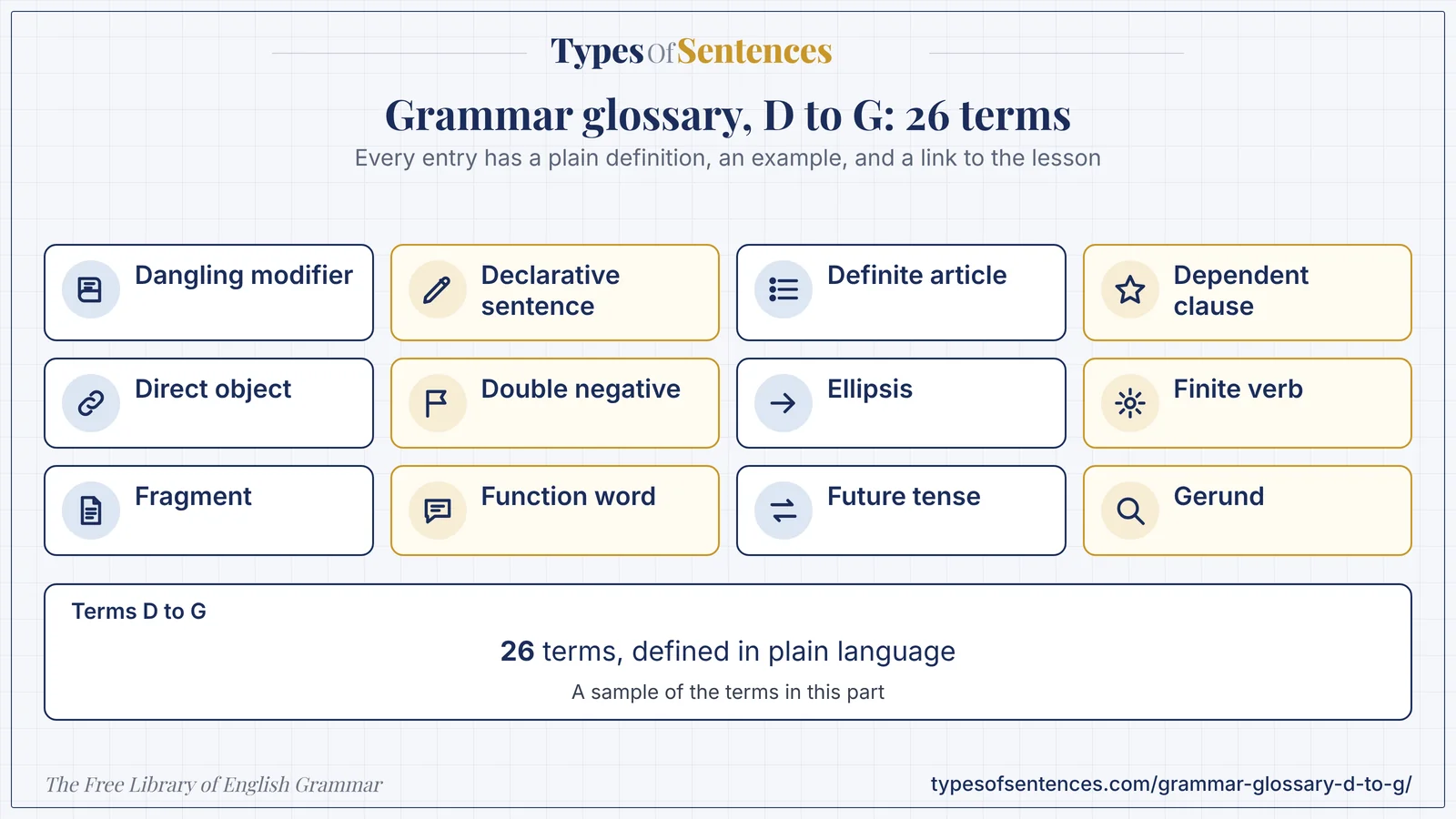
This part of the glossary covers terms from D to G. Many of them are about sentence trouble (dangling modifier, fragment, fused sentence) or about the parts of a sentence (direct object, determiner).
Why it matters: Knowing the name of an error makes it easier to find it and fix it.
Summary: This part of the glossary defines 26 grammar terms from dangling modifier to gerund, with an example for each and a link to the full lesson. Terms are in alphabetical order, and the letter list takes you to each section.
- Entries: a definition, an example, and a link to the lesson.
- Includes the dashes, the finite verb, and the main sentence errors.
- Previous part: A to C. Next part: H to M.
- The terms for the verb forms are linked to the verb lessons.
Jump to a Letter
D
dangling modifier
Definition: A modifier that has no clear word to modify in the sentence, so it seems to describe the wrong thing.
Example: Walking home, the rain started. (incorrect) Walking home, I felt the rain start. (correct)
Learn more: Common Grammar Errors
dash
Definition: A punctuation mark longer than a hyphen. The en dash (–) joins ranges, and the em dash (—) sets off a break in thought or an extra element.
Example: pages 10–20; The answer—surprisingly—was no.
Learn more: Advanced Punctuation
declarative sentence
Definition: A sentence that makes a statement and usually ends with a period.
Example: The train leaves at noon.
Learn more: Declarative Sentence: Definition, Rules and Examples
definite article
Definition: The word the, used before a noun that the speaker and listener can both identify.
Example: Please close the door.
Learn more: What is an Article – A, An, The
demonstrative
Definition: A word that points to a person or thing and shows how near or far it is: this, that, these, those. It can be a determiner or a pronoun.
Example: this book (determiner); That is mine. (pronoun)
Learn more: Types of Pronouns – Complete Study
dependent clause
Definition: A clause that has a subject and a verb but cannot stand alone as a sentence. It is also called a subordinate clause.
Example: because it was late
Learn more: Independent Clause and Dependent Clause Explained
derivation
Definition: The making of a new word by adding a prefix or suffix, or by changing the word class.
Example: happy → happiness; teach → teacher
Learn more: Prefixes and Suffixes – Word Formation Basics
determiner
Definition: A word that comes before a noun and shows which one, whose, or how many. Articles, demonstratives, possessives, and quantifiers are determiners.
Example: the, my, those, some
Learn more: Determiners in English – The Words Before Nouns
direct object
Definition: The noun or pronoun that receives the action of a transitive verb. It answers what? or whom? after the verb.
Example: She wrote a letter.
Learn more: Direct Object and Indirect Object
direct speech
Definition: The exact words that a speaker says, written in quotation marks.
Example: She said, “I am tired.”
Learn more: Reported Speech – Direct and Indirect Speech
double negative
Definition: The use of two negative words in one clause. In standard English, it is avoided, because the negatives are read as canceling or as nonstandard emphasis.
Example: I don’t know nothing. (nonstandard)
Learn more: Common Grammar Errors
E
ellipsis
Definition: The leaving out of words that the reader can supply from the context. The mark of three dots (…) is also called an ellipsis.
Example: Some like tea; others, coffee.
Learn more: Redundancy and Economy
em dash
Definition: A long dash (—), about the width of the letter M, used to set off an interruption or an extra element.
Example: The plan—if there was one—failed.
Learn more: Advanced Punctuation
en dash
Definition: A dash (–), about the width of the letter N, used for ranges and for connections between words.
Example: 2020–2024; the Delhi–Mumbai flight
Learn more: Advanced Punctuation
exclamation mark
Definition: The punctuation mark (!) used after an exclamation, an interjection, or a command of strong feeling.
Example: What a beautiful day!
Learn more: End Punctuation
exclamatory sentence
Definition: A sentence that expresses strong feeling and ends with an exclamation mark.
Example: How lovely it is!
Learn more: Exclamatory Sentence: Definition, Rules and Punctuation
expletive (grammatical)
Definition: A word, such as there or it, that fills the subject position without meaning anything itself. In this sense, the word has nothing to do with swearing.
Example: There is a problem. It is raining.
Learn more: Elements of a Sentence
F
finite verb
Definition: A verb form that shows tense and agrees with a subject, so it can be the main verb of a clause. Infinitives, participles, and gerunds are non-finite.
Example: She walks. (walks is finite; to walk is non-finite)
Learn more: Finite and Non-Finite Verbs: Differences and Examples
first person
Definition: The form of pronouns and verbs used for the speaker or writer: I, me, we, us.
Example: I am here.
Learn more: Types of Pronouns – Complete Study
fragment
Definition: A group of words that is punctuated as a sentence but is not a complete sentence. See sentence fragment.
Example: Because it was late.
Learn more: Sentence Fragments
function word
Definition: A word with mainly a grammatical job, such as an article, preposition, conjunction, or auxiliary verb. The opposite is a content word.
Example: the, of, and, can
Learn more: What is a Word
fused sentence
Definition: Two independent clauses run together with no punctuation or conjunction. It is also called a run-on sentence.
Example: It rained we left. (incorrect)
Learn more: Run-On Sentences
future tense
Definition: A form that refers to a time after now. English has no single future ending; it uses will, be going to, and other forms.
Example: I will call you. It is going to rain.
Learn more: Simple Future Tense
G
gender
Definition: In grammar, the classification of nouns and pronouns as masculine, feminine, or neuter. English marks gender mainly in the third-person singular pronouns.
Example: he, she, it
Learn more: Types of Pronouns – Complete Study
genitive case
Definition: The case that shows possession or a close relation, also called the possessive case. In English, it is shown by ’s or by of.
Example: the teacher’s desk, the end of the road
Learn more: The Noun – Types of Nouns, A Complete Study
gerund
Definition: The -ing form of a verb used as a noun.
Example: Swimming is good exercise.
Learn more: What Is a Gerund? Introduction to Gerunds
Recap in 12 seconds
Watch the lesson build itself: A sample of the 26 grammar terms from D to G: dangling modifier, declarative sentence, definite article, dependent clause, direct object, double negative, ellipsis, finite verb, fragment, function word, future tense, gerund. The video has no sound.
Frequently Asked Questions
What is in the grammar glossary D to G?
This part lists the grammar terms starting with D, E, F, and G, from dangling modifier to gerund, including determiner, direct object, ellipsis, finite verb, and fused sentence.
What is a dangling modifier?
A dangling modifier is a modifier with no clear word to modify, so that the sentence seems to say something illogical. To fix it, name the doer of the action in the main clause.
What is the difference between an en dash and an em dash?
The en dash (–) is about the width of an N and joins ranges and connections. The em dash (—) is about the width of an M and sets off interruptions and extra information.
What is the difference between finite and non-finite verbs?
A finite verb shows tense and agrees with its subject (she walks). A non-finite verb (an infinitive, a participle, or a gerund) does not.
- Huddleston, Rodney, and Geoffrey K. Pullum. A Student’s Introduction to English Grammar. Cambridge University Press, 2005.: standard definitions of grammatical terms.
- Crystal, David. A Dictionary of Linguistics and Phonetics. 6th ed. Blackwell, 2008.: a reference for the terms.
- The Chicago Manual of Style. University of Chicago Press. (check the current edition): the dashes and the ellipsis.
- Merriam-Webster Dictionary: gerund: the dictionary entry.
Last reviewed: October 29, 2026. How it was made: drafted with AI assistance, then checked with automated tests (structure, links, spelling) and against the sources above. A person has not yet read this glossary line by line. Found a mistake? Report it.