This grammar glossary Q to S explains the grammar terms starting with Q, R, and S in plain language. Each entry gives a short definition, an example, and a link to the lesson on this site that teaches the topic in full. If you need the subject definition in grammar, the difference between a relative clause and a subordinate clause, or the meaning of stative verb and split infinitive, you will find it here.
The glossary is in six parts, and this is the fifth. It continues from N to P and is followed by T to Z. The grammar terms starting with S include sentence, simple sentence, subject, subordinate clause, and syntax: the vocabulary that grammar uses to talk about the structure of sentences.
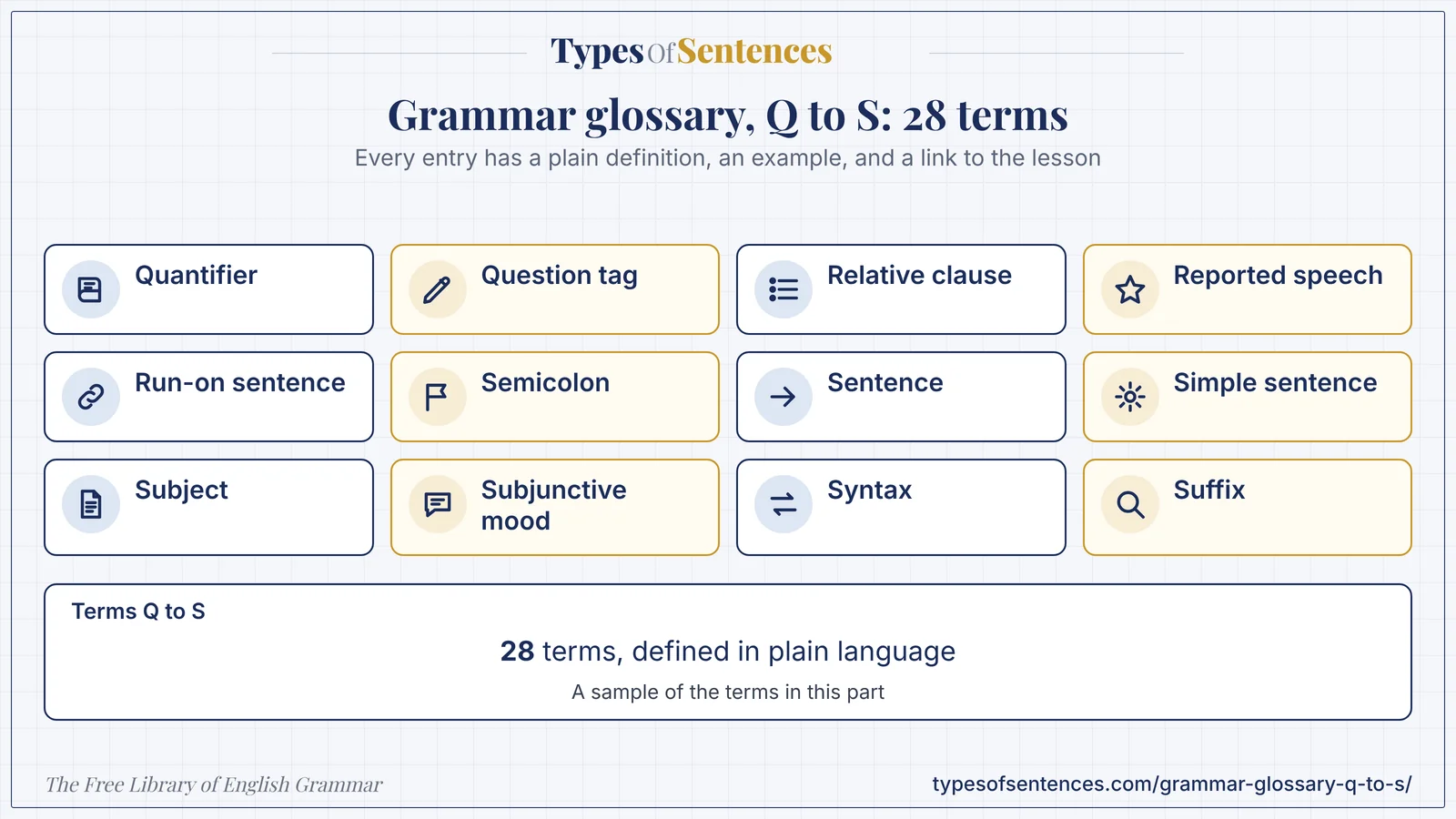
This part of the glossary covers terms from Q to S. The largest group is about sentences and clauses: what a sentence is, what the subject is, and how clauses are joined.
Why it matters: Once you know these terms, a grammar book reads much more easily.
Summary: This part of the glossary defines 28 grammar terms from quantifier to syntax, with an example for each and a link to the full lesson. Terms are in alphabetical order, and the letter list takes you to each section.
- Entries: a definition, an example, and a link to the lesson.
- Includes the relative words and the kinds of clauses.
- Previous part: N to P. Next part: T to Z.
- The split infinitive is explained as a myth in the advanced lessons.
Jump to a Letter
Q
quantifier
Definition: A word or phrase that shows how much or how many. Quantifiers are a kind of determiner.
Example: some, many, few, a lot of, every
Learn more: Quantifiers in English – How Much and How Many
question mark
Definition: The punctuation mark (?) that ends a direct question.
Example: Where do you live?
Learn more: End Punctuation
question tag
Definition: A short question added to the end of a statement to ask for agreement or confirmation.
Example: It’s cold, isn’t it?
Learn more: Functional Grammar – Grammar for Real Communication
quotation marks
Definition: Punctuation marks (“ ”) that enclose the exact words of a speaker or a quoted text, or a title of a short work. In American style, double marks are used first and single marks inside them.
Example: She said, “I’m tired.”
Learn more: Quotation Marks (Basic)
R
reflexive pronoun
Definition: A pronoun ending in -self or -selves that refers back to the subject of the clause.
Example: She hurt herself. We taught ourselves.
Learn more: Types of Pronouns – Complete Study
regular verb
Definition: A verb that forms its past tense and past participle by adding -ed (or -d).
Example: walk, walked, walked
Learn more: Types of Verbs – Complete Study
relative adverb
Definition: An adverb that introduces a relative clause and refers to a time, a place, or a reason: when, where, why.
Example: the town where I was born
Learn more: Relative Adverbs: When, Where and Why with Examples
relative clause
Definition: A dependent clause that gives more information about a noun. It is introduced by a relative pronoun or a relative adverb, or by no word at all. See also adjective clause.
Example: the book that I read
Learn more: Adjective Clauses (Relative Clauses)
relative pronoun
Definition: A pronoun that introduces a relative clause and refers back to a noun: who, whom, whose, which, that.
Example: the woman who called
Learn more: Relative Pronouns: Who, Whom, Whose, Which and That
reported speech
Definition: A report of what someone said, without the exact words. It is also called indirect speech.
Example: He said that he would come.
Learn more: Reported Speech – Direct and Indirect Speech
restrictive clause
Definition: A clause that is needed to identify the noun it modifies, so it is not set off by commas. The opposite is a nonrestrictive clause.
Example: The students who passed were happy. (only some students)
Learn more: Adjective Clauses (Relative Clauses)
run-on sentence
Definition: Two or more independent clauses run together without the punctuation or conjunction needed to separate them. A fused sentence is one kind, and a comma splice is another.
Example: It rained we stayed in. (incorrect)
Learn more: Run-On Sentences
S
second person
Definition: The form of pronouns and verbs used for the person or people spoken to: you, your.
Example: You are welcome.
Learn more: Types of Pronouns – Complete Study
semicolon
Definition: A punctuation mark (;) that joins two closely related independent clauses, or separates items in a list that already contains commas.
Example: It rained; we stayed in.
Learn more: Punctuation Marks – Complete Study
sentence
Definition: A group of words that expresses a complete thought, with a subject and a predicate, beginning with a capital letter and ending with end punctuation.
Example: The train leaves at noon.
Learn more: What is a Sentence?
sentence fragment
Definition: A group of words that is punctuated as a sentence but lacks a subject, a finite verb, or a complete thought.
Example: Because it was late. (incorrect as a sentence)
Learn more: Sentence Fragments
simple sentence
Definition: A sentence with one independent clause and no dependent clause.
Example: The dog barked.
Learn more: Simple Sentences
singular
Definition: The form of a word that refers to one person or thing.
Example: cat, child, she
Learn more: Plural Nouns – Singular and Plural Rules
split infinitive
Definition: An infinitive with a word, usually an adverb, between to and the verb. It is grammatical, and style guides today accept it.
Example: to boldly go
Learn more: Advanced Grammar Myths
stative verb
Definition: A verb that describes a state rather than an action, such as a feeling, a thought, or a possession. Stative verbs are not usually used in the progressive.
Example: know, love, belong, seem
Learn more: Types of Verbs – Complete Study
subject
Definition: The word or phrase that tells who or what the sentence is about, and that the verb agrees with.
Example: The dog barked.
Learn more: Subject and Predicate
subject complement
Definition: A word or phrase after a linking verb that describes or renames the subject.
Example: She is a doctor. The soup tastes good.
Learn more: Subject and Object Complements
subjunctive mood
Definition: The mood of the verb used for wishes, requirements, and unreal or hypothetical conditions.
Example: If I were you, I would go. I insist that he be present.
Learn more: Other Conditional Patterns
subordinate clause
Definition: Another name for a dependent clause: a clause that cannot stand alone and that depends on a main clause.
Example: when the bell rang
Learn more: Independent Clause and Dependent Clause Explained
subordinating conjunction
Definition: A conjunction that introduces a dependent clause and links it to a main clause.
Example: because, although, if, when, while
Learn more: Subordinating Conjunctions: List, Rules and Examples
suffix
Definition: An affix added to the end of a word to change its meaning or word class.
Example: happiness, quickly, teacher
Learn more: Prefixes and Suffixes – Word Formation Basics
superlative
Definition: The form of an adjective or adverb that expresses the highest degree, made with -est or most.
Example: tallest, most carefully
Learn more: Adjective Types – Adjectives, A Complete Study
syntax
Definition: The rules for arranging words into phrases, clauses, and sentences; the structure of sentences.
Example: The cat sat on the mat. is good syntax; Mat the on sat cat the. is not.
Learn more: Syntax and Sentence Processing
Recap in 12 seconds
Watch the lesson build itself: A sample of the 28 grammar terms from Q to S: quantifier, question tag, relative clause, reported speech, run-on sentence, semicolon, sentence, simple sentence, subject, subjunctive mood, syntax, suffix. The video has no sound.
Frequently Asked Questions
What is in the grammar glossary Q to S?
This part lists the grammar terms starting with Q, R, and S, from quantifier to syntax, including relative clause, reported speech, sentence, subject, subordinating conjunction, and suffix.
What is the subject definition in grammar?
The subject is the word or phrase that tells who or what a sentence is about and that the verb agrees with. In The dog barked, the subject is the dog.
Is a split infinitive wrong?
No. A split infinitive is grammatical, and major style guides accept it; the rule against it is a myth, as the advanced lesson on grammar myths explains.
What is the difference between a restrictive and a nonrestrictive clause?
A restrictive clause identifies the noun and takes no commas; a nonrestrictive clause adds extra information and is set off by commas.
- Huddleston, Rodney, and Geoffrey K. Pullum. A Student’s Introduction to English Grammar. Cambridge University Press, 2005.: standard definitions of grammatical terms.
- Crystal, David. A Dictionary of Linguistics and Phonetics. 6th ed. Blackwell, 2008.: a reference for the terms.
- Quirk, Randolph, Sidney Greenbaum, Geoffrey Leech, and Jan Svartvik. A Comprehensive Grammar of the English Language. Longman, 1985.: a reference grammar.
- Merriam-Webster Dictionary: syntax: the dictionary entry.
Last reviewed: October 29, 2026. How it was made: drafted with AI assistance, then checked with automated tests (structure, links, spelling) and against the sources above. A person has not yet read this glossary line by line. Found a mistake? Report it.